
A delivered order is not a finished transaction. Once the unit is fitted and running, the complaints start: not charging, noise, voltage that will not settle. Each one arrives with the same assumption — the alternator is faulty — and that assumption is wrong often enough to matter.
The cost of a wrong claim is not one unit. It is a replacement unit, two-way international freight, weeks of correspondence, and a workshop that quietly lowers its opinion of your product. On a part that sells for tens of dollars wholesale, freight alone can exceed the purchase value.
The harder point: a tired battery, a corroded ground, a slipping belt or a charging-control fault all present exactly like a failed alternator. Without a triage routine, the distributor pays for problems that were never theirs.
In short
Triage the charging system before judging the unit. Most "alternator faults" are a battery, a ground, a belt or an installation error — and a claim filed without that check costs freight twice.
Key points
- Check the whole charging system before judging the unit; most "alternator faults" sit in the battery, the wiring, the belt or the installation.
- Evidence decides speed: OE number and label, fault video, voltage data and diagnostic report, sent once.
- A six-step claim routine replaces ad-hoc messaging.
- Five warranty terms belong in the PO: period, scope, evidence, freight, timelines.
- Choose suppliers on fitment accuracy, process control and after-sales response, not price alone.
1. Three fault types, and why the label matters less than the check
When a workshop reports a problem, the useful first move is classification, not a verdict. Most of what arrives as signs failing alternator ends up split three ways.
| Fault type | What it looks like | Unit-side causes | Vehicle-side causes |
|---|---|---|---|
| No charge | Battery light, no voltage rise after start, flat battery while driving | Regulator, rectifier, rotor or stator | B+ cable, connector or ground, belt slip, excitation or control signal |
| Noise | Continuous rumble, whine rising with rpm, chirp near the belt, vibration | Bearing wear, internal contact | OAP/OAD pulley, belt tension or age, misalignment, tensioner, idler or water pump |
| Voltage fault | Low or high charging voltage, fluctuation, intermittent lamp, electrical symptoms | Regulator, rectifier diodes | Aged battery, high resistance in the output path, charging-control signal |
Owners and workshops rarely describe it in these terms. What arrives is closer to a list of questions — how to tell if car alternator is going bad, how do you know if car alternator is bad, signs of failing car alternator — and an owner asking how do i tell if my alternator is going bad gets the same honest answer: the complaint only narrows the search. Two notes matter more than the table.
On LIN or another smart charging strategy, the alternator follows the vehicle's control signal: diagnose signal, wiring and fault codes with the OEM procedure first. Smart charging also varies output with battery state, temperature, engine load and demand, so one reading proves little.
2. Five checks before anyone files a claim
This is where most money is saved. If the real fault is a battery, a ground or a cable, ten replacements will not fix it — and each one adds freight and erodes confidence.
- Check 1 — Battery. Can it hold charge, is it aged, does a load test pass? A resting reading below 12.4V makes the battery the suspect, and what looks like signs of a weak alternator (slow cranking, dim lights at idle) is usually the battery first.
- Check 2 — Cables and ground. B+ output, connector and ground straps: tight, clean, correct. A voltage-drop test on both sides of the circuit finds resistance a visual check misses.
- Check 3 — Belt and pulley. Tension, wear, alignment, and the OAP/OAD overrunning pulley function — locked one way, free the other. Record cracks, glazing and pulley run-out.
- Check 4 — Fitment. OE number, rated voltage and current, connector type, mounting dimensions, pulley specification — the points an OE number selection guide exists to settle. Similar appearance is not equivalence.
- Check 5 — Charging control. Fault codes, battery sensor, communication status, and the OEM test plan for that model.
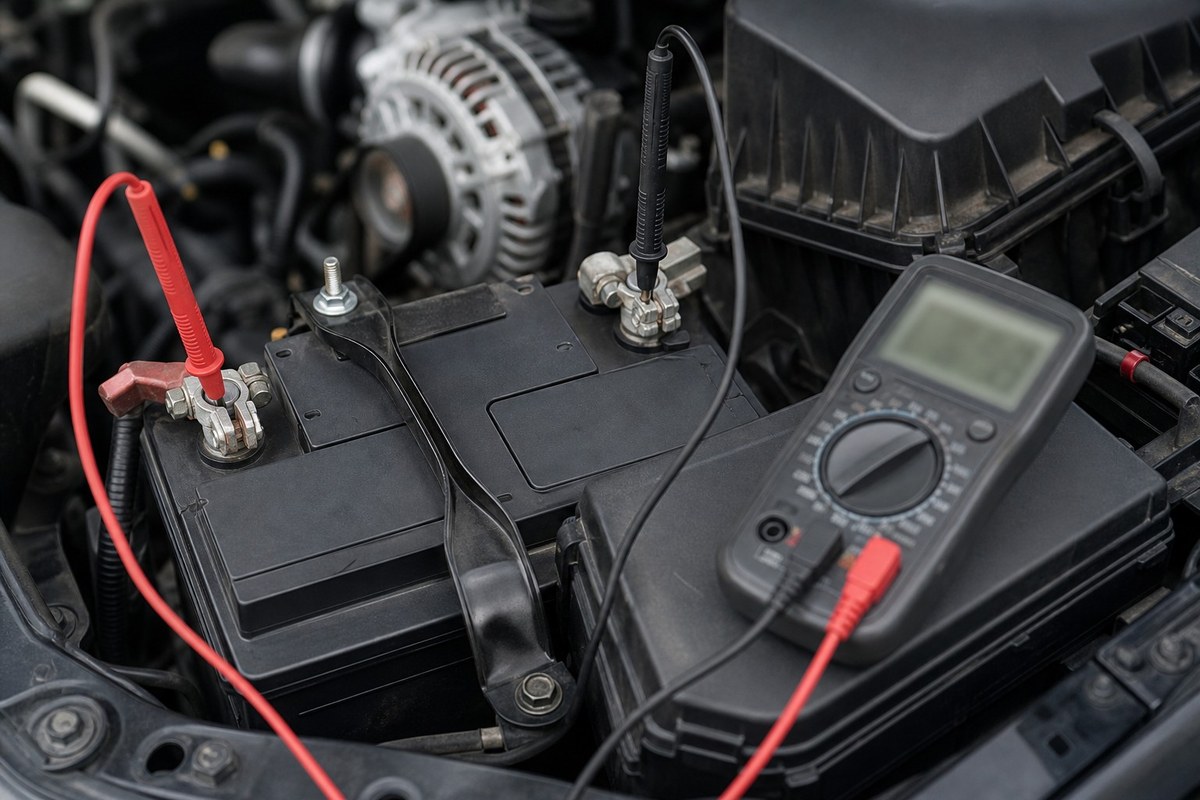
On measurement: how do you test an alternator usefully? Record battery voltage with the engine off, at idle, and with lights and air conditioning on, then compare the B+ output against the battery post. A battery alternator tester is convenient, and free alternator testing at a parts store gives a number, but the number only means something next to the model's specification. One reading at idle is not a test: how to check alternator with meter results properly is at rest, at idle and under load, with the probe position noted each time.
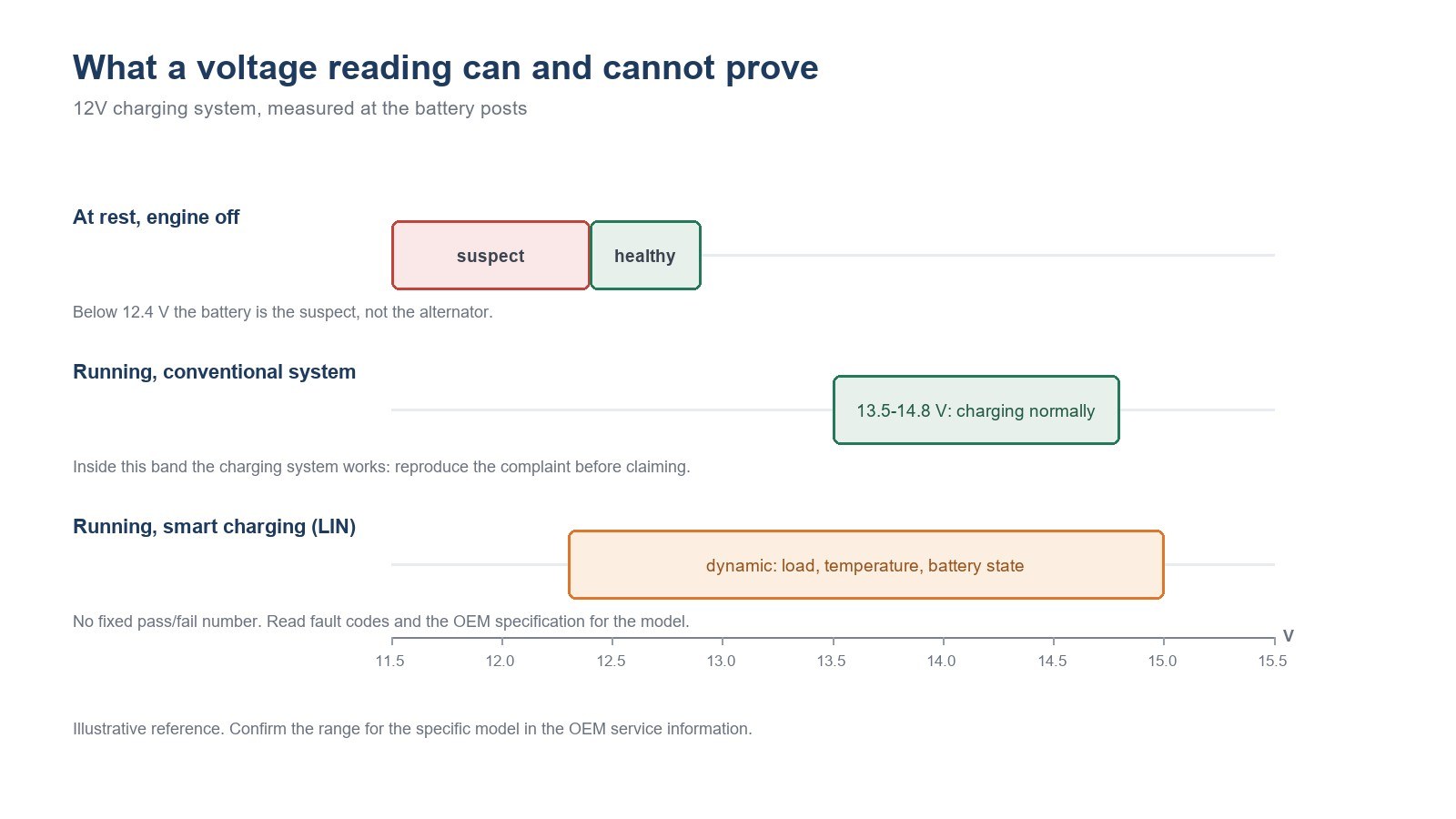
Two shortcuts to avoid. You can check an alternator with a multimeter in two minutes; testing alternator with multimeter readings at three load points takes ten and settles the case. And how to test alternator by disconnecting battery is a procedure that can damage modern electronics — do not endorse it. If a workshop asks how to test an alternator without a multimeter, the answer is: borrow one, or send the vehicle to someone who has one.
3. Three disputes that decide who pays
Three disputes decide most of these cases, and each starts with a question rather than a finding: how to tell if an alternator is going bad, how do you know if alternator is going bad, how do you know if your alternator is broken.
The car still does not charge after a new unit is fitted
The workshop concludes the new alternator is faulty. Usually the original fault was never in the alternator: a poor B+ connection, a bad ground, or a battery at the end of its life. If the owner is wondering how to tell if your car alternator is going bad, this is the case where the answer is "it probably is not".
Handle it by asking for battery state, B+ and ground readings and the control signal status before any replacement ships. Fix the vehicle side, retest, then decide. "New unit, still not charging" is not evidence of a defective part, even when the workshop frames it as how to tell if my alternator is bad.
Noise after installation, blamed on the bearing
A rumble is reported and a bearing failure assumed. Often the noise comes from the tensioner, an idler or the overrunning pulley. When someone asks how do you know when alternator is going bad from noise alone, the answer is that you do not.
Method: engine off, release the belt, spin the alternator and each idler by hand and compare feel and sound, or use a stethoscope. If the noise disappears with the belt off, the alternator is unlikely to be the source.
Failure after weeks or months of service
A unit that fails after time in service needs history, not assumption. Service time, mileage, failure location and environment all count: heat, water ingress, overload and poor installation shorten life. Signs of alternator going out after two years in a hot climate are not the same finding as the same symptom after two weeks, and neither is proof of a defect.
Ask for the label, failure photos, service records and a test report; if the cause is still unclear, arrange a return inspection under the agreed terms. One sign of alternator going out, on its own, decides nothing. Time in service is not a verdict either way.
4. Responsibility at a glance
| Finding | Responsibility | Action |
|---|---|---|
| Battery aged, flat or failed | Vehicle | Fix battery, retest, no claim |
| Loose or corroded wiring, high voltage drop | Vehicle | Repair circuit, retest |
| Belt, tensioner, idler or pump | Vehicle | Replace accessory parts |
| Wrong OE number, plug or pulley spec | Selection or dispatch | Confirm against the order, supply the correct unit |
| Incorrect installation | Installation | Technical guidance, terms apply |
| Internal regulator, rectifier or bearing fault with external causes excluded | Product | Formal claim with full evidence |
| LIN or control module fault | Vehicle | Diagnose the vehicle, no claim |
| Heat, water or overload damage | Per warranty terms | Decide under the agreed scope |
The logic is elimination: work down the table until the only remaining explanation is the unit. If someone needs a quick way to check how do you tell if an alternator is bad without a bay full of tools, this table is a better starting point than any single reading.
5. The evidence pack
Two groups, sent together.
Basic claim file. OE number, model, brand, PO number; unit and label photos including the serial; vehicle make, model, year and engine; installation date, mileage, workshop; fault description with timing and frequency.
Technical file. Fault video, especially for noise and intermittent faults; voltage readings at rest, running and under load; diagnostic report with fault codes; B+ and ground voltage-drop results; a note of what has already been repaired or replaced.
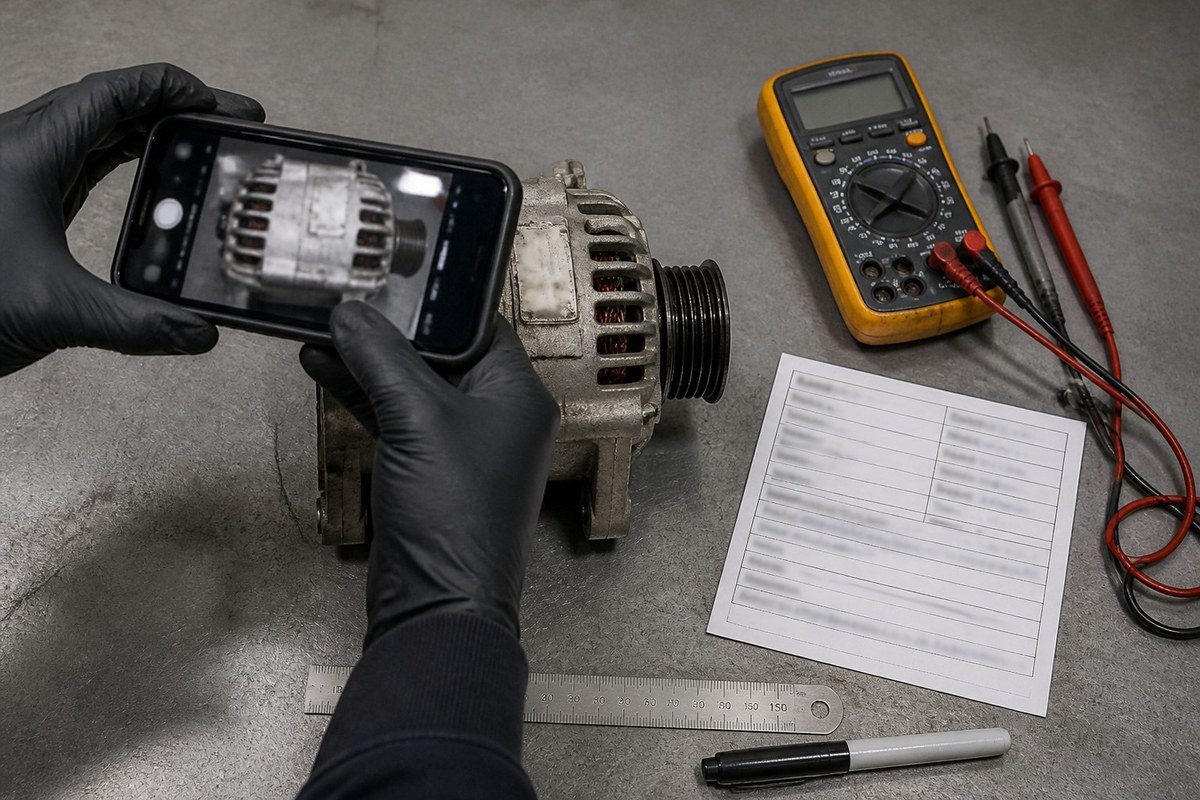
Three items do most of the work: the label and OE number prove identity and batch; a clear video beats a paragraph for noise and intermittent faults; concrete data — where the reading was taken, in which condition, with which result — is what lets a supplier conclude. If a workshop asks how to test car alternator with multimeter results you can act on, the answer is: at the battery posts, engine off, at idle and under load, written down. When a shop has no meter at all, how to test a car alternator becomes a scheduling problem, not a technical one — and how to test car alternator, how to know if you have a bad alternator are the same request in different words.
6. Six steps from complaint to closure
- Log the report. OE number, batch, installation date, mileage, symptom, work already done.
- Run the five checks. Vehicle side first, unit second.
- Submit once. The full evidence pack, not fragments.
- Supplier review. Cause analysis against the data and terms; incomplete files get a specific list of gaps.
- Agreed remedy. Replacement, repair, credit or technical support under the written terms — not a verbal arrangement.
- Close the file. Cause, remedy, cost, days to close, and the customer's response.
On goodwill: claim review takes time and the workshop has a car on the lift. For long-standing accounts, shipping a replacement with the case still open — costs settled once responsibility is known — protects the relationship better than a credit note later. Set the conditions in advance and record every instance.
If the same number or batch repeats, stop replacing units one at a time and ask for a root-cause report (8D or equivalent): containment, cause, corrective action. That report belongs in your next sourcing review.
7. Five warranty terms to settle before the PO
- Period and start date. Shipment, receipt or installation? How is the period calculated when transit and storage take weeks?
- Scope. What counts as a product fault, and what is wear, wrong installation, misuse or another vehicle system?
- Evidence and approval. Which photos, videos, reports and purchase records are required? Is prior approval needed before returning a unit?
- Freight and inspection. Who pays return freight, inspection and replacement shipping? Cross-border returns are expensive enough that silence becomes a dispute.
- Timelines and cost boundaries. Response time after a complete file, remedy after acceptance, and a clear split between product liability and labour, removal, downtime or consequential loss.
Put all five into the contract annex or the warranty confirmation. Terms agreed after a failure are rarely terms at all.
8. Choosing a supplier whose after-sales can carry a claim
Five things matter more than price:
- Fitment accuracy. Can they confirm the specification from the OE number, the vehicle and the variant?
- Process control. Component sourcing, in-process checks and outgoing inspection: is batch variation controlled?
- Response capability. A named contact who collects data, discusses the case and reports progress.
- Transparency. Are period, conditions, cost allocation and remedy stated before the order?
- Continuity. Can they keep supplying the numbers you actually sell, and support an investigation when one is needed?
9. FAQ
Can we just ask for a replacement when a unit under warranty will not charge?
No — not first. Complete the five checks. If the fault is on the vehicle side, a new unit will not fix it and you have paid the freight twice. If the unit is confirmed faulty, claim with the full file.
Noise always means the bearing, does it not?
No. Tensioner, idler, overrunning pulley, water pump and the belt itself produce similar sounds. Release the belt, spin each component, and compare. If the noise goes away with the belt off, the alternator is probably not the cause.
Who pays cross-border return freight?
Whatever the contract says. Confirm before purchase: how freight is split when a product fault is confirmed, and who pays when the finding is a misdiagnosis or a vehicle fault.
Must the failed unit come back?
Depends on the terms. Visual faults can often be settled from photos and video; internal electrical faults or batch issues usually require an inspection. Agree the trigger conditions in advance.
Is there a quick way to tell whether the unit is at fault?
Only after the vehicle side is excluded. How can you check if the alternator is bad without testing the battery and the ground is the same route with a step missing. How can you tell if your car alternator is bad, or how to know your alternator is bad, are not phone-call questions — and pretending otherwise is how wrong claims start.
What is different about LIN or smart-charging vehicles?
Output follows the vehicle's control signal and varies with conditions, so a static reading proves little. The claim needs fault codes, communication status and multi-condition voltage data.
10. Closing
A no-charge complaint, a noise or a voltage anomaly is a symptom, not a verdict. Triage the system, judge responsibility on evidence, submit one complete file, and settle the terms before the order. Do that, and after-sales stops being a discount you pay for someone else's fault.
Related parts
Units from our range. Send an OE number and we will check fitment before quoting.
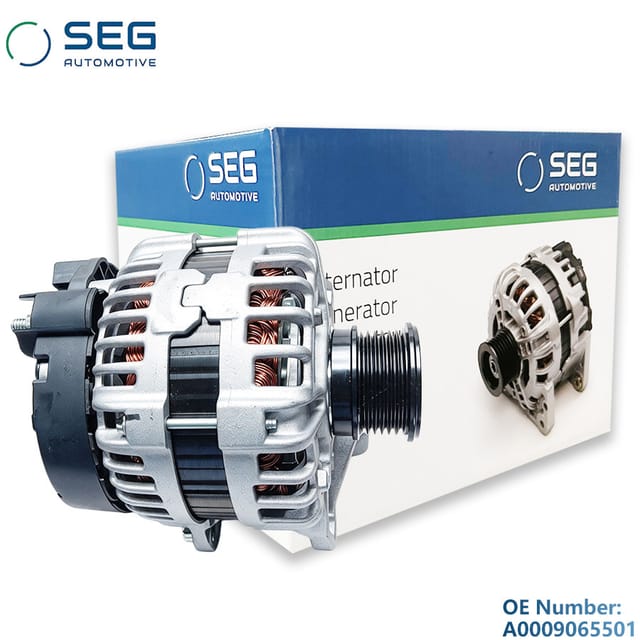 SEG Alternator 12V for Mercedes-Benz GLK 250 (A0009065501)
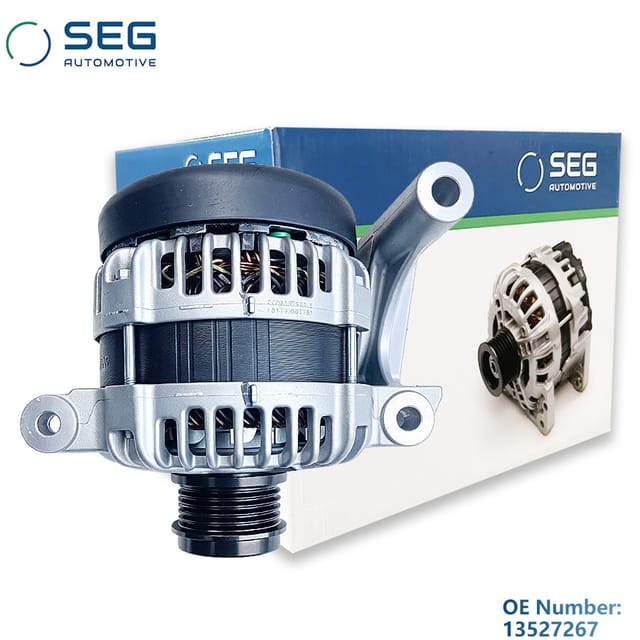 SEG Alternator 12V for Buick Envision 1.5T (13527267)
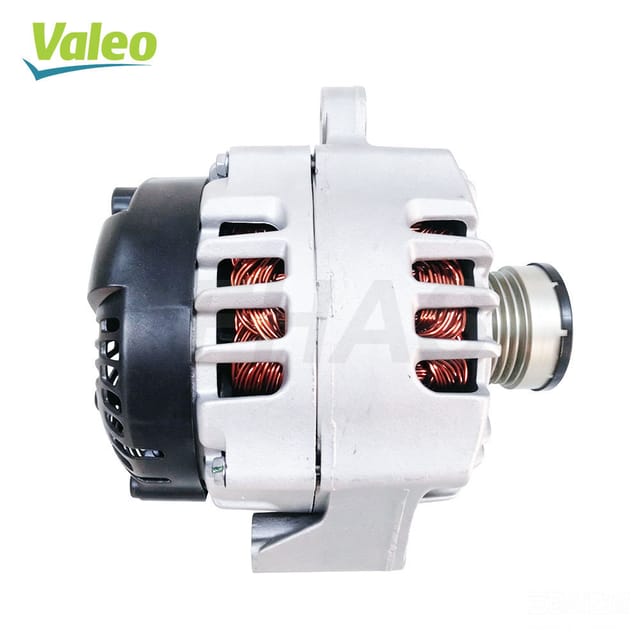 Valeo Alternator 12V 140A for Roewe W5 (TG14S030SV)
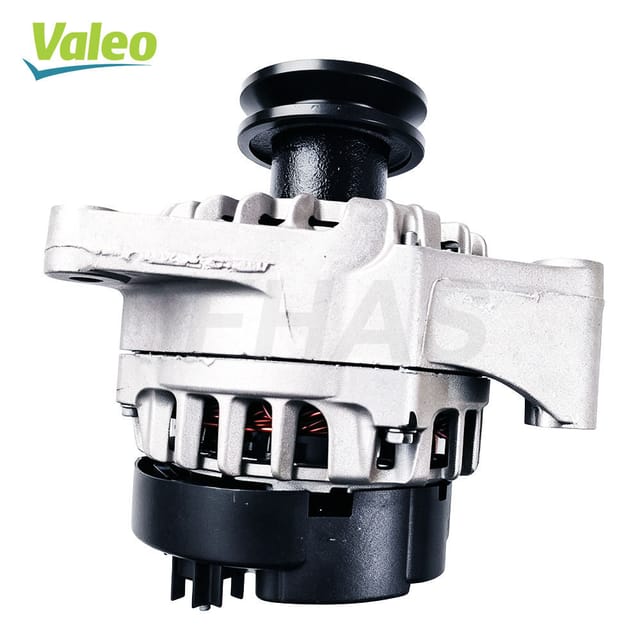 Valeo Alternator 12V 90A for VW Santana (330903015B)
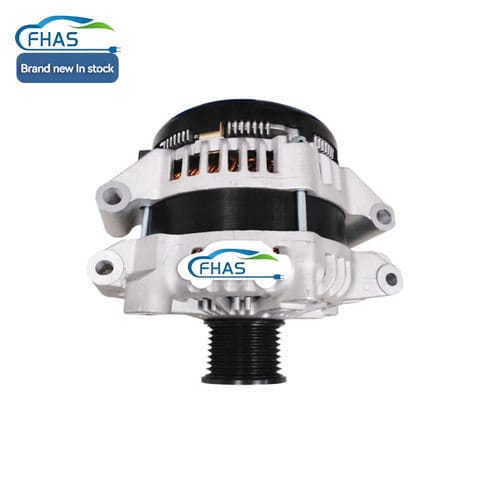 JHAEM Alternator 12V 210A for BMW 523 / 528 / X3 3.0
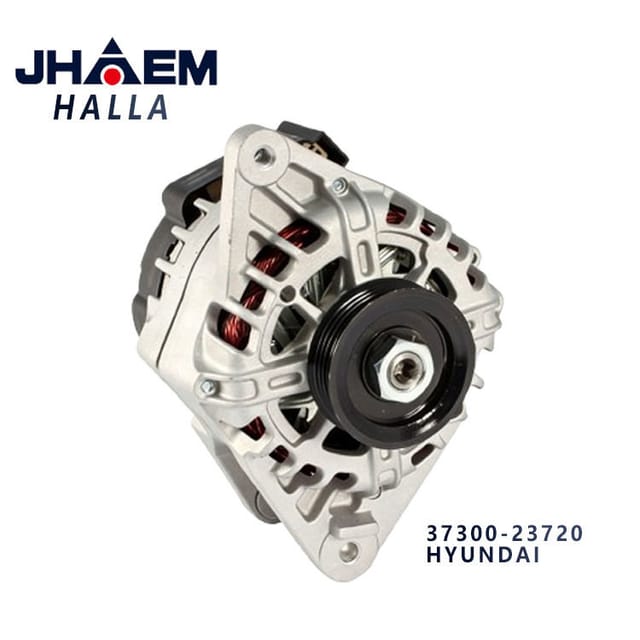 JHAEM Alternator 12V 90A for Hyundai / Kia
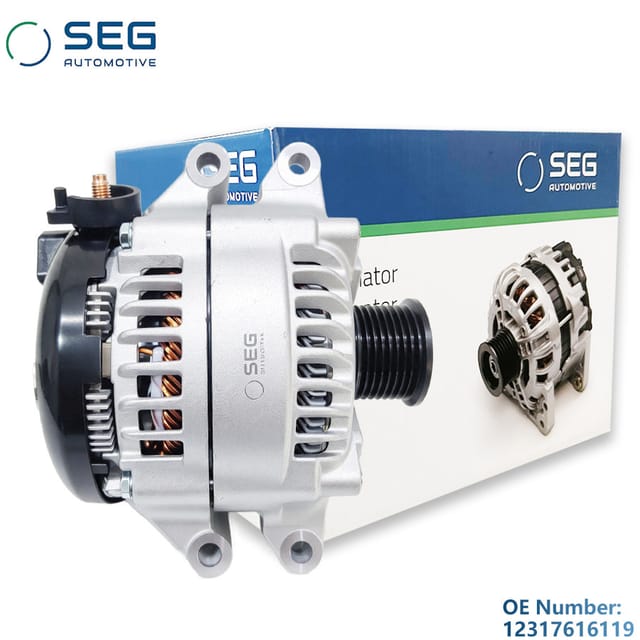 SEG Alternator 12V for BMW F18/535GT (12317616119)
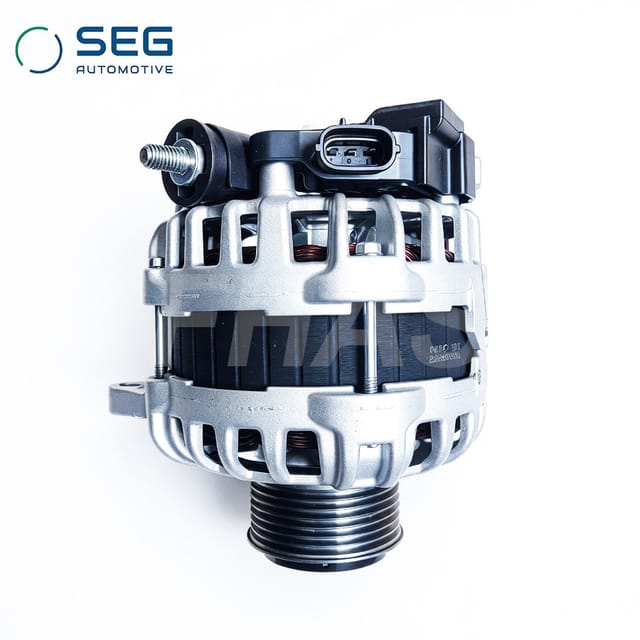 SEG Alternator 12V for Nissan Navara 2.5 Repair (231004KV0A)
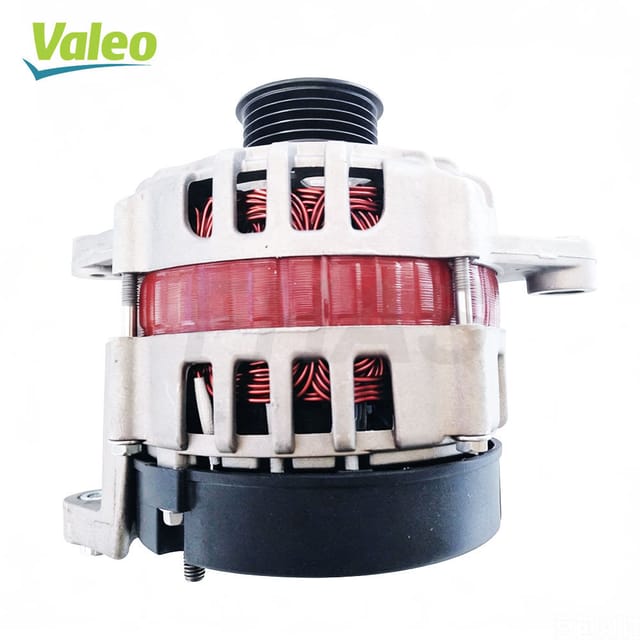 Valeo Alternator 12V 85A for Buick Excelle (9046972)
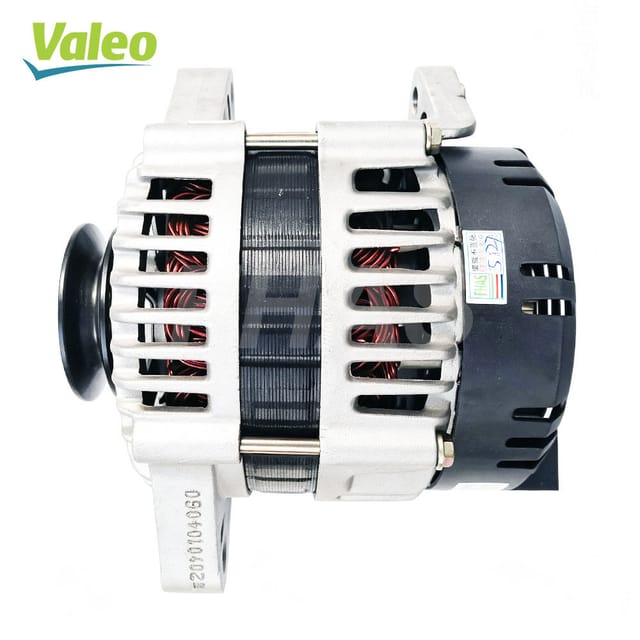 Valeo Alternator 12V 65A for Suzuki Alto (3701010B3)
Have a part number to price?
Send it over with the quantity and destination. You will get a fitment check, a unit price and a freight cost — usually the same business day.